Thoughts on Reconstruction As Reflected in "The Wife of His Youth"
Fundamentally, Charles Chesnutt's "The Wife of His Youth" is about the process of reconciling two people's life stories, which, having once been intertwined under slavery, had since diverged, especially after the Civil War. Mr. Ryder, who before the war had run away from slavery in Missouri, had by some unspecified method escaped to the North, where he had gotten a job and worked his way up to a middle-class life. His wife, on the other hand, had spent the same 25 years traveling around the country looking for him, supporting herself by working as a cook. The story is set in the city that Mr. Ryder had moved to at the time they finally encounter one another again. Their reunion captures in microcosm the ideal but also some of the difficulties of repairing the damage done by slavery.
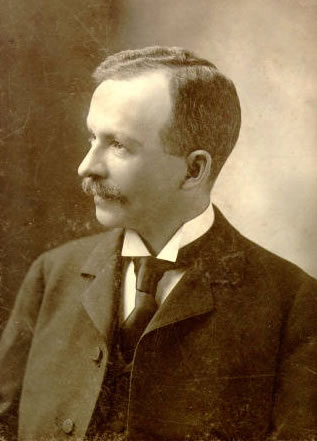
Charles Chesnutt
Mr. Ryder (originally known as Sam Taylor) was a mix of Black and white and had been born free, but upon being orphaned had gone to work for a slaveholder. His wife, Liza Jane, learned that their master intended to sell him regardless; she warned him, and he then ran away. When the master found out that Liza had told Mr. Ryder of his plans, he sold her, thus (intentionally or not) lowering their chances of being able to find each other again. Mr. Ryder settled in a Northern city, where he joined a society of Black people known as the Blue Veins, whose stated purpose was to improve the "social condition" of Black people. In practice, it was for people of mixed heritage and comparatively high socioeconomic standing to congregate and stake out a claim to being their own group, distinct both from the whites and the Blacks. Mr. Ryder had become the de facto leader of the society and had organized a ball where he intended to propose to a woman who had arrived in town several months earlier.
This was the context of Mr. Ryder's reunion with his wife. Having heard of his social preeminence, Liza came to him, told her story, and inquired as to whether he had any knowledge of her husband. Despite professing to know her husband "'mongs' a hund'ed men", she did not recognize him, though he recognized himself in a photograph that she had. Their different paths were starkly captured in their language: Mr. Ryder spoke in a formal style of standard, educated English, while Liza used a distinctly African-American vernacular dialect. That difference also encapsulated the dilemma that Mr. Ryder was faced with. Here in front of him was "the wife of his youth", who had been ripped away from him by the institution of slavery, and whom he had promised to come back for. But complicating what would seem on its face to be a joyous moment of triumph over adversity was the fact that in the intervening years Mr. Ryder had become in effect a completely different person. Marrying a working-class former slave could interfere with his position as leader of a middle- to upper-class society (one which could be called whitewashed), a concern that he himself alludes to ("Perhaps he's outgrown you, and climbed up in the world where he wouldn't care to have you find him"). In addition, he was already planning to propose to a woman of that society that very day.

Example of a daguerreotype, the type of photograph Liza showed Mr. Ryder
Thus we see Reconstruction's ideal of repairing damage from slavery (in this case, getting Liza and Sam/Mr. Ryder back together) being complicated by the realities of war and upheaval. In the end, Mr. Ryder does reveal himself to Liza and change his plans for the ball. Interestingly, he almost seems not to make his decision until the very last minute, after soliciting the advice of the attendees of the ball by presenting his situation as a hypothetical. However, a subtle detail proves the contrary: He had already brought Liza to the venue of the ball. He had to have told her at least that he was her husband, if not his entire plan. His seeming hesitation shows that while he had made his decision, he was still a little nervous about how the Blue Veins would react. Applying that idea to the real world, I think Chesnutt, by writing this story, was expressing the opinion that Reconstruction could succeed, but that it would have to adapt in the face of obstacles because it is impossible to fully right the wrongs of slavery.


I think your reading of Chesnutt's intents when writing this story was correct. In such a volatile and changing environment like that of America during the Reconstruction, making informed decisions would be almost impossible. Mr.Ryder's last-minute decision parallels this nicely, showing how much people had to adapt and improvise during those uncertain times. Nice blog post.
ReplyDeleteI think it's interesting just how long it takes Mr. Ryder to decide to reveal who he was, and I like how show how different he's become. By the time he meets Liza again he's changed so much that it's clear he doesn't really want to go back, which does tie into the social pressures during reconstruction. And I can see how him deciding to come back to his wife shows his willingness to resist these pressures.
ReplyDeleteI completely agree with you! However, I wonder how Chesnutt is depicting the goal of reconstruction. I agree that the best way for Liza Jane and Mr. Ryder to "repair damage from slavery" would be to reunite. However, I wonder whether the reconstruction movement is trying to achieve this. Liza Jane doesn't seem to have had much support in the past 25 years in looking for her husband. I wonder if the goals of the reconstruction movement are more like the goals of society and Chesnutt is showing them fall short here. Either way, I think the message is similar. I also really like your observation about how Mr. Ryder had already brought Liza Jane to the ball. I didn't think of it that way.
ReplyDeleteI agree with your thesis statement: that it was necessary for the reconstruction movement to acknowledge that it could never right the wrongs of slavery. Your blog post helped illuminate how this might've been Chesnutt's overarching point, by making the characters of "The Wife of His Youth" interact in the way that they did. However, I'm not entirely convinced that Mr. Ryder told Liza he was her wife before the big reveal; it's not totally inconceivable to me that she just stuck around until the ball started (maybe Mr. Ryder told her that he had something important to tell her and didn't specify). I feel like Chesnutt might've wanted to add this surprise factor for extra dramatic effect and to make Mr. Ryder appear unsure until the end.
ReplyDeleteI like your thesis statement, the story makes much more sense with your interpretation of the purpose and meaning behind it. I thought that your final sentence was especially interesting; when I read the story I thought that Chesnutt was simply expressing his favor to being true to oneself and sacrificing status for what is right, but him expressing his opinion on the practicality of reconstruction seems more fitting. I also liked your analysis of the implications of the difference in dialect between Mr. Ryder and his wife.
ReplyDelete